My Newest Playlist: Monk’s Music
Jazz Buddies,
Since I’m not a ‘talk radio’ person at all, as well as not very impressed with today’s music offerings on radio (similar to our parents 50 years ago!) − like social media, I don’t do satellite radio − my rare exposure to straightahead/bebop Jazz music while in my car is Baltimore’s WEAA and Washington, D.C.’s WPFW radio stations during limited time slots. Of course, while at home, I’m in Jazz ‘Heaven’ in my “man cave”!
So while driving, I’ve come to mostly resort to and mainly rely on personally curated playlists on my iPhone (downloaded iTunes songs) for a pleasurable road experience, including two straightahead Jazz playlists: ‘Jazz 03’ and ‘Jazz 04’ (~400 songs total).
My primary sources for finding about the latest straightahead/bebop Jazz music to download are independent Jazz label websites, Jazz magazines & websites, radio stations, ‘live’ concerts, and word of mouth.
Since I’m also a huge 1970s/80s R&B fan (the music still sounds amazingly incredible 40-50 years later!), I also have on my iPhone individual playlists for the following artists/groups (slow tunes): Stevie Wonder, Stylistics, EW&F (fast), EW&F (slow), Isley Brothers, Ohio Players, Phyllis Hyman, Whispers (fast), Whispers (slow), Atlantic Starr, Luther Vandross, Luther Vandross (duets), Freddie Jackson, and Whitney Houston.
Surprisingly, I don’t have any playlists on my iPhone for any individual Jazz artists. Well, not until now…
For me, a huge Jazz fan, the mere mention of the name “Thelonious Monk” (1917-1982) invokes thoughts, feelings, and emotions of beautiful music of the highest standards, chock full of melody, harmony, and rhythm, from a true icon of the art form.
During my process of “discovering” straightahead/bebop Jazz in the late 1970s, as well as identifying my “Big 7”, including Monk, my first impressions upon hearing his sound on piano were of shock, amazement, and be-wilderness. “What is that sound???” His piano sound was definitely unique, perhaps from playing two adjacent white keys at the same time.
Also, while some of his tunes seemed very simple (“Blue Monk”, “Nutty”), other tunes seemed very haunting (“Crepuscule With Nellie”, “Monk’s Mood”, “Ugly Beauty”), very beautiful (“Pannonica”, “Ruby, My Dear”), rhythmically and harmonically complex (“Evidence”, “Epistrophy”, “Straight, No Chaser”), eerie sounding (“Light Blue”, “Mysterioso”, “Brilliant Corners”), and cleverly titled (“Eronel” is ‘Lenore’ spelled backward, eponymous “Thelonious”, record producer “Teo” Macero), Monk’s masterful piano playing of the highest order (“Trinkle, Tinkle”, “Four In One”) could not be overlooked. Wow!!!
Of course, Monk’s most famous and most frequently recorded composition, as well as a staple for all Jazz musicians to know how to play a ballad (besides “Body And Soul” and “Lush Life“), is “ ‘Round Midnight”.
Not to mention the plethora of tunes that just swung hard (“I Mean You”, “Rhythm-A-Ning”, “Well, You Needn’t”).
And most importantly, Monk’s compositions were unique sounding, very challenging, instantly recognizable, AND stayed in your head for a long time (causing you to hum them)! Perhaps Jazz’s most prolific composer, second only to Duke Ellington, Monk is known to have composed approximately 70 songs, many of which are Jazz standards and Jazz classics.
So much so that many of his 1940s/50s contemporaries, and continuing on to today’s young lions and one-time teenage phenoms (Eldar, Christian Sands, Joey Alexander, Brandon Goldberg), featured signature Monk tunes on their albums. It’s as if an album (or concert) is not quite complete unless it features a Monk or Ellington tune. For me, if a young pianist can flawlessly play “Trinkle, Tinkle” or “Four In One”, then he/she has my vote! :v)
In the early 1980s, as I journeyed into this art form called ‘straightahead/bebop Jazz’, I became more eager to find out about “this Thelonious ‘Sphere’ Monk guy”, his mystique, and his music. Of course, he’d graced the cover of Time Magazine on February 28th, 1964, and his Prestige and Columbia album covers that I’d observed in used record stores were legendary and thought provoking.
My first serious exposure to his music was through the group, Sphere, initially a tribute band comprised of two former Monk Quartet members, saxophonist Charlie Rouse and drummer Ben Riley, along with pianist Kenny Barron and bassist Buster Williams. The group recorded seven (7) outstanding albums from 1982 to 1987, with the first one, titled “Four In One”, recorded on the day Monk passed, February 17, 1982.
Monk’s storied life and career in 1940s New York City’s Harlem includes: mentoring from stride pianist great James P. Johnson, house band pianist at the famous Minton’s Playhouse, present during the emergence of Bebop along with Parker, Gillespie, Roach, and Powell, member of the Coleman Hawkins Sextet, member Dizzy Gillespie Big Band, and leader of his own groups.
However, because his piano sound was so different (people thought he couldn’t play) and his style of playing was percussive (he was decades ahead of his time!), he had trouble finding work in the late 1940s and early 1950s.
In an ugly chapter of this nation’s history, New York City Police used the Cabaret Card Law to discriminate against Black Jazz musicians. The New York City Cabaret Identification Card was a permit that was required of all workers, including performers, in nightclubs in New York City from Prohibition to 1967.
Thelonious Monk first had his cabaret card revoked in 1948 after an arrest for marijuana possession. He lost it again in 1951 after a narcotics arrest with his buddy, pianist Bud Powell, for holding heroin belonging to Powell. As a result, Monk was unable to perform in New York clubs for six years. And, finally, in 1958, his cabaret card was revoked after an altercation with Delaware state troopers.
Despite these hard times, forward-thinking and visionary record producers (Alfred Lion, Orrin Keepnews, Teo Macero) realized that they literally had a musical genius within their grasp. Hence, Monk’s music continued to be recorded and released to critical acclaim and wide audience appeal, winning the Down Beat Critics Poll as Best Jazz Pianist in 1957 and 1958, as well as selling out at night clubs, playing in town halls, touring Europe, AND appearing on the cover of TIME Magazine!
Along with listening to Sphere albums in the 1980s, I found that several other artists included Monk’s tunes on their albums, so I became more familiar with his compositions. Back then, ‘Liner Notes’, which I consumed at every opportunity, were a treasure trove for artist information and backstories…
Add to this the incredible and critically-acclaimed 1988 documentary film, titled Thelonious Monk: Straight, No Chaser, about the life and career of Monk, which included unforgettable intimate video and audio footage of the Jazz master and his family.
In addition, two very interesting French television documentaries about Monk, “Jazz Portrait: Thelonious Monk” (30 min.) and “Rewind & Play” (60 min.), were broadcasted in 1970 and screened in Toronto last April (2022), respectively. The footage for both films are drawn from Monk’s December 1969 concert performance at the Salle Pleyel concert hall and interviews at a public television studio in Paris.
The latter film, a re-edit of the former, uses unedited raw footage, much of it unreleased until then, including outtakes. Although both films had mixed reviews, including the interviewer’s perceived exploitation of Monk, the footage of Monk in performance – his playing, artistry, and creativity – is amazing and unforgettable!!
In the early 1990s, with record companies on the verge of eventually phasing out 12-inch vinyl albums (and beautiful artwork!) and replacing them with Compact Discs (CDs), many established Jazz labels began re-issuing 1950s/60s albums, as well as never-before-released recordings, in CD format. These labels included: Blue Note, Capitol/Pacific, Emarcy/Verve/Mercury, Prestige/Riverside, Savoy, Impulse, and Columbia.
As a result, Jazz aficionados and Jazz collectors alike were able to procure highly sought after and seminal recordings by many great Jazz legends that were previously either out-of-print, scarce, or not available. Also, Japanese import CDs and Mosaic box sets became available. However, for those audiophiles with discernible or fine-tuned ears, it took some time to adjust to digital sound quality of CDs vs. analog sound quality of albums. :v(
Since I was already on a mission to build up my 1950s/60s straightahead/bebop Jazz library, including Thelonious Monk’s music, I proceeded full speed ahead in seeking out and procuring new and used CDs from record stores and via Amazon.com.
My worn-out copy of the 1,378-page All Music Guide to Jazz: The Experts’ Guide to the Best Jazz Recordings, 3rd Edition (aka “the Jazz Bible”), which I purchased brand new, as well as reading the back covers of CD cases, certainly had their roles in guiding me in the right direction. Over the years, l successfully built up my CD collection of 1950s/60s straightahead/bebop Jazz to number over 1,350, including 45 titles by Thelonious Monk (see below).
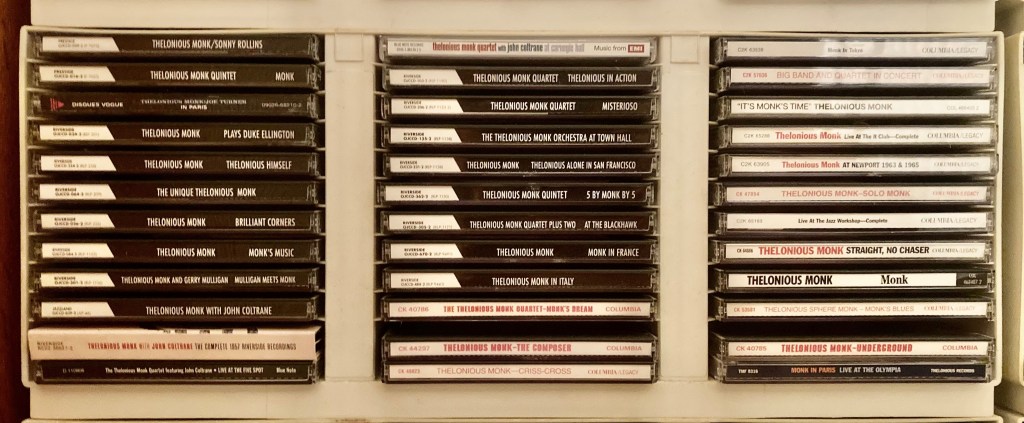
In fact, over the years, I’ve had my series of ‘Monk moods’ when, in the span of several days, I’d play and listen to only Monk CDs, wishing to soak in and get lost in the beauty and ambiance of his music and artistry. After I’d gotten my fill of Monk, I’d get on with my life… playing other artists’ albums and CDs. :v)
And in 2005, lo and behold, like a bolt of lightening, the Jazz world got news of a new Monk recording! It turns out that in January of that year, a recording lab supervisor at the Library of Congress, while transferring the library’s tape archive to digital, accidentally came across a tape in an unmarked box of a November 29, 1957, concert at Carnegie Hall.
This “historic” recording, which was made by Voice of America radio network, featured the Thelonious Monk Quartet with John Coltrane!!! This instant classic CD of nine songs, released on Blue Note Records in September of that year, goes down as one of the truly great finds in Jazz lore.
Monk’s music legacy has been maintained over the years, in part, by the Thelonious Monk Institute of Jazz, a non-profit education organization founded in 1986 with a mission to offer the world’s most promising young musicians college level training by internationally acclaimed Jazz masters and to present public school music education programs for young people around the world. Its annual International Competition, established in 1987, is the most prestigious event of its kind, recognized for discovering the next generation of Jazz masters.
The competition focuses on a different instrument each year (e.g., trumpet, saxophone, trombone, guitar, piano, bass, drums, percussion, vocals, etc.) and features an all-star judging panel on that instrument. I’ve had the pleasure and good fortune of attending the semi-finals and/or the finals a few times in the 1990s, as well as in 2013.
At these annual events, it was also a sheer pleasure to hear Monk’s son, T.S. Monk, a wonderful storyteller and an accomplished drummer, speak and share great anecdotes about growing up with his sister, Barbara, and mom, Nellie, in the Monk household. I always found it rather infectious how gleefully T.S. referred to his dad as ‘Thelonious’, not ‘dad’…
As impressive as the young artists and future ‘young lions’ who competed were, even more amazing, incredible, and unbelievable was the opportunity to see living legends and icons, especially the older ones, in the flesh, whose classic albums I had at home, a virtual Who’s Who of Jazz.
For example, in 1996, the saxophone judges were: Jackie McLean, Jimmy Heath, Wayne Shorter, Joe Lovano, and Joshua Redman. In 1997, the trumpet judges were: Art Farmer, Jon Faddis, Arturo Sandoval, Randy Brecker, and Wallace Roney. And in 2013, the saxophone judges were: Jimmy Heath, Wayne Shorter, Bobby Watson, Jane Ira Bloom, and Branford Marsalis. Wow!!!
In 2019, the Thelonious Monk Institute of Jazz was renamed the Herbie Hancock Institute of Jazz, after its longtime board chairman.
Finally, during my weeklong NYC Jazz pilgrimage trip from the Bay Area in September 2006, while hanging out at a late-night jam session at Harlem’s famous Minton’s Playhouse, I had the opportunity to meet Rome Neal, an actor who, at the time, was performing in the critical-acclaimed Off-Broadway one-man play titled, ‘Monk,’ about the life and times of Thelonious Monk. He was performing the play at the historic Nuyorican Poets Cafe, located in Alphabet City in the East Village. The music was scored by Bill Lee, the father of Spike Lee. And even though I did not get a chance to see him perform it ‘live’, I did purchase a DVD from him and watched it later. It was an outstanding portrayal of Mr. Monk!
So, with that in mind, for your sheer enjoyment and pleasure, I’ve culled from my rich collection of albums, CDs, and iTunes downloads, a list of 60 Monk selections performed by a vast array of notable Jazz artists young and old, including Monk, and in no particle order. That is, of course, with the exception of starting off the festivities with Monk’s solo treatment of “Trinkle, Tinkle”… So, please fasten your seat belts, get comfortable, listen up, and be prepared for a melodic, harmonic, and rhythmic rollercoaster ride!!
- Trinkle, Tinkle – Thelonious Monk (solo) (1971)
- Ruby, My Dear – Dexter Gordon (1978)
- Light Blue – Arthur Blythe w/John Hicks (duet) (2001)
- Monk’s Mood – Hank Jones (solo) (2004)
- Monk’s Dream – Tim Ray (2016)
- Eronel – Eric Reed (2011)
- Evidence – Monk’s Music Trio (2007)
- Criss Cross – Joey Alexander (2016)
- Pannonica – Tuomo Uusitalo (2016)
- Evidence and Four In One – Danilo Perez (1996)
- ‘Round Midnight – Harry Allen & Scott Hamilton (2012)
- Crepescule For Nellie – Thelonious Monk (solo) (1971)
- Ask Me Now – Falkner Evans (2006)
- Brilliant Corners – Dollar Brand (Abdullah Ibrahim) (1964)
- I Mean You – Aaron Goldberg (2010)
- Light Blue – Kenny Barron (solo) (2016)
- Think Of One – Robert Glasper (2009)
- We See – Fred Hersch (2016)
- Well, You Needn’t – Brandon Goldberg (2019)
- Evidence – Teodross Avery (2020)
- Trinkle, Tinkle – Teodross Avery (2020)
- Epistrophy – Thelonious Monk w/John Coltrane (1957)
- In Walked Bud – Hod O’Brien (2006)
- Bye-Ya – Tim Ray (2023)
- Straight, No Chaser – Eldar Djangirov (2006)
- Reflections – Will Bonness (2016)
- Hackensack – Eric Hargett (2016)
- Off Minor – Quentin Baxter (2021)
- Green Chimneys – Etienne Charles (2013)
- Crepuscule For Nellie – Jason Moran (2010)
- Thelonious – Monk’s Music Trio (2003)
- Blue Monk – Barry Harris (1990)
- Let’s Cool One – Ted Rosenthal (2001)
- Mysterioso – Jessica Williams (2004)
- Jackie-ing – Kenny Barron (1992)
- Bemsha Swing – Bill Evans (1963)
- San Francisco Holiday – Bruce Barth (2002)
- Teo – Ellis Marsalis (2008)
- Little Rootie Tootie – Chick Corea (1981)
- Work – Mulgrew Miller (1986)
- North Of The Sunset – Tommy Flanagan (1982)
- Nutty – Mike Longo (2017)
- Ba-Lue Bolivar Ba-Lues-Are – Geoff Keezer (1989)
- Skippy – Brad Mehldau (2004)
- ‘Round Midnight – Jaki Byard (solo) (1979)
- Introspection – Glenn Zaleski (solo) (2022)
- Raise Four – Isaiah J. Thompson (2022)
- Ugly Beauty – Kevin Hays (1992)
- Ruby, My Dear – Ronnie Mathews (1989)
- Four In One – Stanley Cowell (1991)
- Rhythm-A-Ning – Larry Willis (2007)
- Medley: Monk’s Mood / Ask Me Now – Sullivan Fortner w/Roy Hargrove (duet) (2018)
- Blue Sphere – Thelonious Monk (solo) (1971)
- Gallops Gallop – Peter Zak (2011)
- Played Twice – Bob Hallahan (2014)
- Boo Boo’s Birthday – Greg Thompkins (2003)
- Friday The 13th – Howard Riley (solo) (1994)
- Oska T – Tim Warfield (2015)
- Bright Mississippi – Renee Rosnes (1989)
- Coming On The Hudson – Sonny Fortune (1994)
Yes, never enough Monk!!!
Kenneth
 kacbooksread